Your Most Expensive Treatment May Be Your Least Profitable
Why the Price of a Treatment Does Not Reveal Its True Value
When we ask the doctors we work with which treatment they consider the most profitable in their practice, the answers are usually immediate: “fillers”, “laser treatments” or “mesotherapy”.
In most cases, their assessment is based on the price they charge for each treatment. However, a higher price does not necessarily mean a higher financial return.
The treatment price tells you how much revenue you generate from a session. The financial contribution per hour tells you how much remains after deducting the direct cost of consumables, relative to the time required to perform the treatment.
These are two different measures, and they can lead to very different conclusions about the financial performance of your practice's treatments.
The Calculation Often Missing from Business Decisions
To gain an initial understanding of the financial performance of each treatment, you need three key figures:
- The price charged to the patient.
- The cost of consumables used.
- The total time required to perform the treatment.
The basic calculation is:
(Treatment price − Cost of consumables) ÷ Total hours spent = Gross contribution per hour
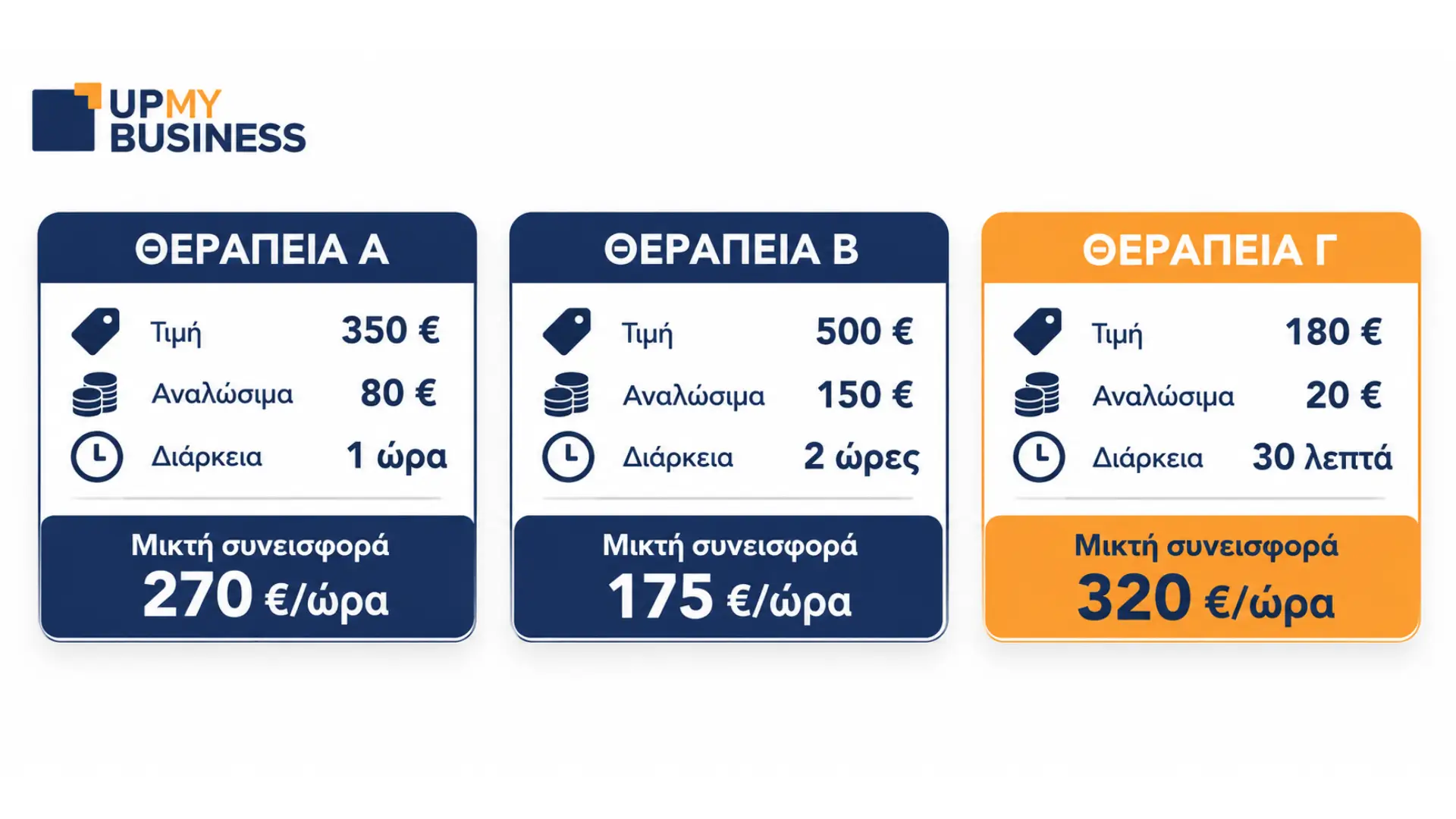
Let's look at three illustrative examples:
Treatment A
- Price charged to the patient: €350
- Cost of consumables: €80
- Duration: 1 hour
- Gross contribution: €270/hour
Treatment B
- Price charged to the patient: €500
- Cost of consumables: €150
- Duration: 2 hours
- Gross contribution: €175/hour
Treatment C
- Price charged to the patient: €180
- Cost of consumables: €20
- Duration: 30 minutes
- Gross contribution: €320/hour
As you can see, Treatment C, despite having the lowest price, generates the highest gross contribution per hour.
This does not necessarily mean it is the most profitable treatment overall. To calculate net profitability, you also need to account for other operating expenses, such as staff costs, equipment depreciation and maintenance, as well as the general operating costs of the practice.
Nevertheless, this calculation provides a valuable first step towards evaluating the financial performance of your services.
What Can You Do with This Information?
The calculation becomes truly valuable when it helps you make better decisions about how to manage each treatment and which direction to take in order to maximise your practice's growth.
There are four key areas to consider:
1. Increase Visibility and Promotion
If a treatment generates a high financial contribution but is performed relatively infrequently, it is worth exploring whether there is an opportunity to increase demand.
Where there is genuine patient interest and the treatment is appropriate for your target audience, you can strengthen awareness and visibility through your website, social media channels and communication with your patients, always in compliance with applicable data protection regulations and medical advertising standards.
2. Maintain and Optimise Performance
When a treatment delivers a strong financial contribution and enjoys consistent demand, the objective is to maintain that balance.
Consider whether appointments could be organised more efficiently, whether available time is being used effectively and whether your team can meet demand without compromising the quality of care and services provided.
3. Review Your Pricing Strategy
If a treatment enjoys consistent demand but generates a relatively low financial contribution per hour, it may be time to review its pricing.
Many practices continue to apply price lists established several years ago, without taking into account increases in consumable costs, equipment maintenance expenses or the actual time required to perform each treatment.
Any pricing adjustments should be based on total costs, market conditions, demand and the value of the service provided.
4. Allocate Resources More Effectively
A doctor's time is often one of the most valuable resources in a medical practice.
If a task or treatment can legally be delegated to an appropriately trained and qualified team member, it is worth considering this option.
For example, one of the doctors we work with discovered that a significant proportion of his time was being spent performing a mesotherapy treatment that generated a relatively low financial contribution per hour. At the same time, the treatment could potentially be performed by an appropriately trained team member, within their legally permitted scope of practice.
Following this operational change, the doctor was able to dedicate more time to other medical procedures that required his direct involvement and generated a higher financial contribution.
Effective delegation is not simply about reducing costs. It is about making better use of the knowledge, time and capabilities of the entire team.
Why Don't Most Practices Make Use of This Information?
The calculation itself is not particularly complicated. The challenge lies in gathering all the necessary information.
The time required for each treatment, consumable costs, revenue and treatment frequency are often recorded across different systems or are not consistently documented.
Without systematic data collection and analysis, it is difficult to gain a complete picture of the financial performance of each service.
In many cases, there is a significant information gap because the data stored in your CRM system does not provide this level of analysis. As a result, you may be missing valuable opportunities to review your strategy and make changes that could increase your practice's profitability.
This is precisely the gap we set out to address at UpMyBusiness.
Using our specialised Clinic Intelligence Tool, developed to provide a comprehensive view of an aesthetic medicine practice's performance, we analyse your existing practice data and turn it into actionable insights that support better business decisions and sustainable growth.
Our goal is to help you identify which treatments perform best, which may require a pricing review and where there are opportunities to make better use of your time and available resources.
What Can a Practice's Data Reveal?
During an analysis conducted as part of our collaboration with a dermatology practice, we discovered that the treatment generating the highest gross contribution per hour accounted for just 12% of total appointments.
By contrast, a treatment with a lower price accounted for more than 30% of appointments.
This finding revealed a significant discrepancy between how frequently treatments were being performed and the financial contribution they generated.
Carry Out an Initial Assessment of Your Own Practice
Choose the three treatments you perform most frequently and record the following information for each:
- The price charged to the patient.
- The cost of consumables.
- The total time involved, including any necessary preparation.
Then apply the following formula:
(Treatment price − Cost of consumables) ÷ Hours spent = Gross contribution per hour
Ask yourself:
- Which of the three treatments generates the highest result?
- Is this also the treatment that occupies the largest proportion of your appointment schedule?
- Most importantly, does the time you dedicate to each treatment reflect the financial contribution it generates for your practice?
The answers may reveal opportunities for improvement that you have not previously identified.
Would You Like to Know What Is Really Driving Your Practice's Performance?
With 25 years of specialised experience in aesthetic medicine, the UpMyBusiness team has developed the Clinic Intelligence Hub: a powerful business intelligence tool designed to give you a comprehensive picture of your practice's performance and help you make better strategic decisions for growth.
By using the Hub together with data from your existing CRM system, you can assess the financial performance of your treatments, identify opportunities to improve pricing and make more effective use of your practice's time and resources — all within minutes.
Your Practice Data, Finally Working for You
Discover the Clinic Intelligence Hub by clicking here and contact us to find out more about how it can help you unlock your practice's full potential.